


Quick Take
Dave Trott, cofounder of the London agency GGT and author of Creative Blindness, has long argued that 89% of advertising is neither noticed nor remembered.1 B2B content faces even longer odds now that AI writes about as many new articles online as people do.2 Our agentic audience intelligence platform, Watchtower, reviewed more than 16,000 public conversations in which B2B buyers talked about vendor content. Buyers said it loses them when it arrives at the wrong point in their buying process or reads as if it were written for anyone.3 The content that earns their attention is tailored to their company and compares the vendor with the other vendors they are evaluating. We call our model for producing it the Content Personalization Spectrum. It has five levels, from generic content written for everyone to living content assembled for each buyer the moment they ask. AI makes the higher levels affordable to produce. The hard part is quality control, meaning automated checks that keep every version accurate and on brand.
The resonance problem
Dave Trott, cofounder of the London advertising agency GGT and author of Creative Blindness, likes to start with a brutal number. By his count, 89% of advertising is neither noticed nor remembered.1 He offers it as a provocation, since the study behind it has never been traced. It still lands with the marketing leaders we work with because it names what they already feel. Their teams are producing more than ever while their buyers notice less.
89%
of advertising is neither noticed nor remembered.
The odds are getting longer. The SEO firm Graphite analyzed 55,400 English-language articles published online and found that AI now writes roughly half of them.2 With more content competing for the same limited attention, being good is no longer enough to get seen.
AI now writes about as many new articles as people do
Why buyers ignore vendor content
To understand why buyers tune out, we used Watchtower to analyze what B2B buyers say about vendor content in public conversations and reviews.3 Across 16,077 of those conversations between October 2025 and October 2026, the five most common reasons buyers gave for dismissing vendor content were close to equally common. Each appeared in between 17% and 22% of conversations.
Why B2B vendor content misses the mark
The reason we least expected was “examples from companies far ahead.” We read this as case studies about customers that are much further along than the buyer. Vendors lead with their most advanced customers to inspire buyers, yet the conversations suggest buyers read those stories as proof of how far behind they are.
Technology buyers say much the same. In Forrester’s 2021 Content Preferences Survey, 51% of technology buyers considered much of the material vendors sent them useless.4
What earns a buyer’s attention
The same research shows what earns attention. In a related set of 16,645 conversations about vendor content that worked, content landed when it compared the vendor with the other vendors the buyer was evaluating (26%), demonstrated an understanding of the buyer’s industry (16%), or addressed a challenge the buyer is facing right now (8%).3
Why B2B vendor content lands
In a separate set of 32,167 conversations about what kind of personalization buyers value, 43% pointed to content fully tailored to their organization. Far fewer pointed to content that reflects the constraints of their sector (18%) or matches where they are in the buying process (16%).3
The personalization buyers value most
Same AI, different results
Most of the factors buyers rewarded come down to relevance, meaning content that reflects their own company, industry, role, and stage of buying. Relevance also depends on how the AI producing it is set up. When we present this research to marketing teams, we show two paragraphs about expense accuracy in the public sector and ask which one AI wrote. AI wrote both. One is generic and the other is written for the reader’s world. The difference comes from how the model was tuned and what it was given to work with. That is why we prioritize relevance and quality over the volume of content we produce.
The Content Personalization Spectrum
One global marketing leader we work with calls tailoring content by industry and by persona, at scale, something of a holy grail. Every planning cycle, the team asks whether this is the year they finally produce industry-specific content. In our experience, personalization stalls when teams treat it as an all-or-nothing choice for their whole content program. We treat it as a spectrum of five levels. Each level changes more of the asset, from a swapped-in name to the whole text, and needs more information about the buyer to do it.
 Generic
 Surface
 Segment
 Account
 Living
We read the buyer research against these levels. Content that understands the buyer’s industry or role needs the segment level. Content fully tailored to the buyer’s organization, the most valued form of personalization at 43%, needs at least the account level. That includes its business priorities and the competitors it faces.3
Account-based marketing (ABM) teams already sort target accounts into one-to-one, one-to-few, and one-to-many tiers. Those tiers decide how much attention each account gets. The spectrum works at the level of the individual asset and decides how far each piece of content adapts to the person reading it.
Real-world examples
Segment by industry: SAP Concur
SAP Concur asked us to create versions of eight existing general-audience assets for finance leaders in state and local government. We built a custom AI setup, a combination of models, agents, and tools grounded in SAP Concur’s brand and messaging, and tuned it over several weeks alongside SAP Concur’s own dedicated reviewers. We estimated that the regular workflow would have taken 24 days per asset, from brief to final packaged asset. Once the setup was tuned, each asset took seven days. Time to a first draft fell by 80%, and revised drafts were ready 60% faster after each round of feedback. In-market results are still to come.

24 to 7
days per asset after tuning, in one eight-asset program.
The biggest lesson came from the reviewers, who kept correcting the wording, terminology, and themes that suit state and local government. That knowledge lived in people’s heads and had never been written down. We now document it and build it into the setup before the first draft.
Segment by role: Microsoft
Microsoft’s Frontier Firm research describes how organizations are starting to work with AI agents alongside people. For Microsoft, we turned that research into eight interactive web guides, called blueprints, each written for a different executive persona, including the CFO, the chief information security officer, and the chief revenue officer. Because the blueprints are interactive, they give Microsoft page-level reading analytics for each version, which a download count cannot provide.

Account: HP
With HP’s ABM team, we are setting up a process in which AI agents tailor campaign content to individual target accounts. It draws on HP’s global content library, data on each account’s interests and activity, what HP’s sellers know about each account, and the campaign formats the ABM team already runs. Not every account gets the same depth. Some accounts get a dedicated campaign, others get content tailored to their industry, and the rest are reached through programmatic campaigns.
Living: AMD
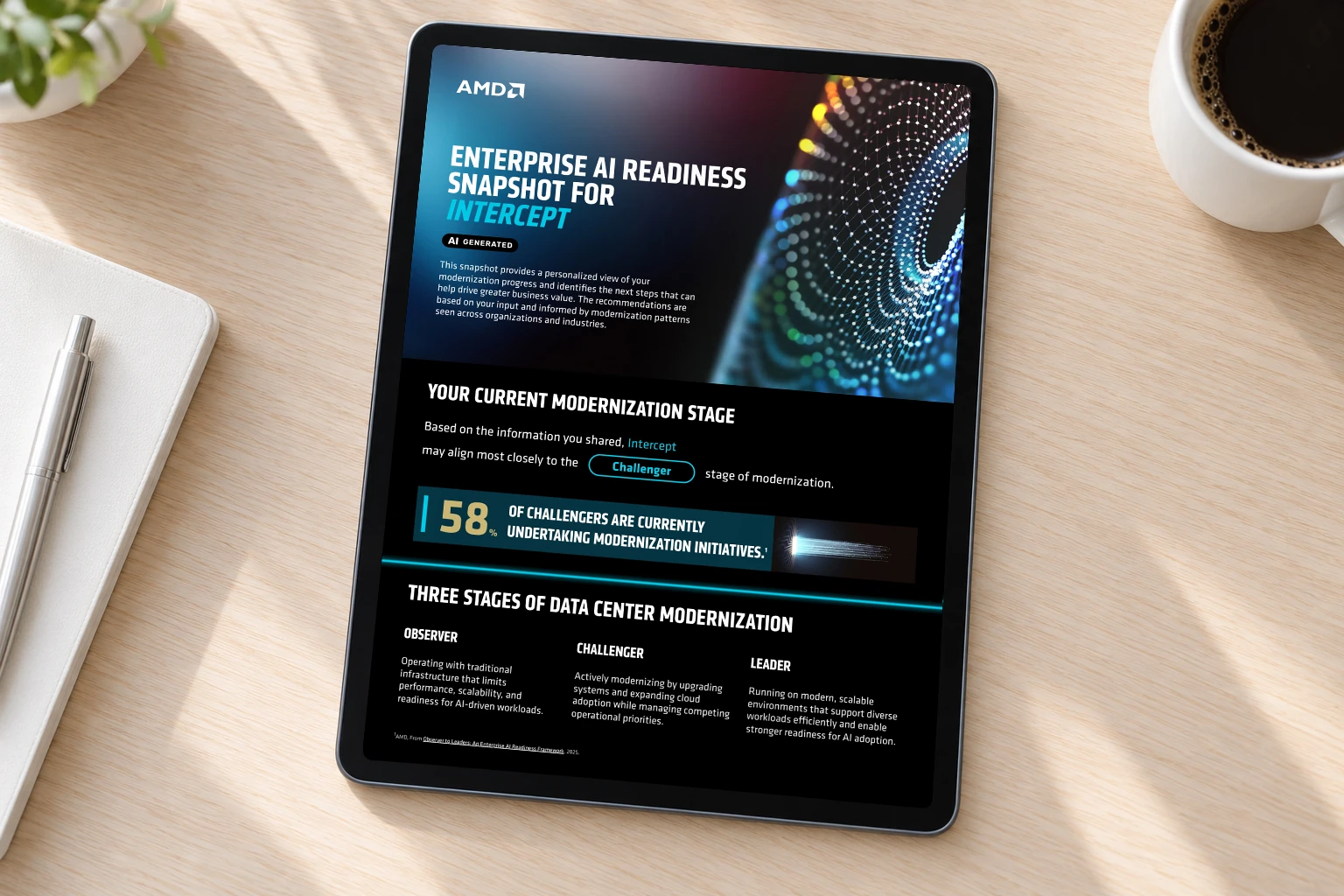
For AMD, we built a living e-book, one that writes a new version of itself for each reader. Our first version asked for an email address up front. Because many people entered a personal address, the system could not tell which company they worked for. Asking a few questions about the reader’s role and situation before requesting a work email worked better. In our demo, the system then wrote a version for that buyer’s company in about 90 seconds, drawing on public information such as earnings calls and annual reports.
The hard part is quality control
AI can now draft a version for every industry, role, or account quickly and cheaply. Making sure every version is accurate and on brand is far harder. Generative AI models are probabilistic, which means the same request can produce a different answer each time. Run the same prompt 100 times and it can return 100 different variants. Quality at that scale depends on deterministic checks, meaning rules that give the same pass or fail result every time they run.
On the AMD e-book, that is where most of the work went. By design, no person reviews a version before it reaches the buyer. People approve the sources, rules, and tests up front instead, and named owners handle ongoing review and escalation. No personal data goes to the AI. We built a test suite of 108 cases and tested the system on 30 companies. Every version must pass six checks. If a draft fails, the system retries up to twice. If it still fails, the buyer receives pre-approved copy. The largest single piece of work was getting AMD’s legal, privacy, and information security teams comfortable with those limits.
The other three programs keep a person in the loop. On the SAP Concur and Microsoft work, and in the HP process being set up, a person approves each asset before it goes out.
Many teams first picture personalization as dynamic content optimization, where they prewrite variants or page modules for software to choose from. A living asset writes new content for each buyer instead. Prewriting a version for every combination of role, industry, company, and buying stage quickly runs into thousands of versions to write and approve. The management writer Michael Hammer made the same point about business processes in Harvard Business Review in 1990, writing that companies “tend to use technology to mechanize old ways of doing business.” His advice was “Don’t automate, obliterate.”5 Writing every version in advance automates the old way. Building the checks once and generating each version inside them replaces it.
Toward an agentic content system
Each of these programs is a step toward something larger: an agentic content system. Today, most teams run personalization as separate projects. Each project has its own model, its own rules, and its own review. In an agentic content system, those parts become shared infrastructure. Your existing content, analytics, and customer data sit at the base. A knowledge layer above it holds what the AI needs to know, including your brand guidelines, your product and service offerings, and the way your content is organized. AI agents work from that knowledge to plan, create, and adapt content for each buyer and for the AI assistants that answer buyers’ questions. Governance runs through every layer. The same quality checks apply to every asset, whichever agent produced it.
In that system, a published asset keeps changing. A buyer who opens it today and returns next week could find it updated with new information about their industry, their company, or the solution they are evaluating. We have not yet seen anyone run that end to end. We have already built parts of it with clients looking to operate at the frontier.
Sources
- 1. Dave Trott, Creative Blindness (and How to Cure It), Harriman House, 2019.
- 2. Graphite, analysis of 55,400 English-language articles sampled from Common Crawl, with AI detection by Pangram, GPTZero, and Copyleaks, 2026.
- 3. Intercept Watchtower, shares of 16,077, 16,645, and 32,167 conversations among finance and travel and expense decision makers, global, October 2025 to October 2026. Watchtower analyzes public conversations on X, Reddit, Quora, Bluesky, and product reviews by a randomly sampled set of business and IT professionals, drawn with a sampling method derived from statistical physics and published in peer-reviewed academic research, then weighted against census data. Margins of error are 1 to 3 percentage points at 95% confidence.
- 4. Forrester, “The B2B Content Guide: Tech Buyers Need Relevant Vendor Content Pre- and Post-Sales” (Forrester’s 2021 Content Preferences Survey), 2022.
- 5. Michael Hammer, “Reengineering Work: Don’t Automate, Obliterate,” Harvard Business Review, July–August 1990.